

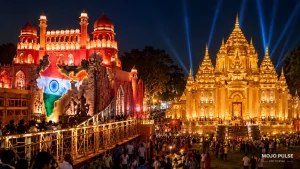
 As Kolkata prepares for its busiest pandal-hopping evenings, police are planning separate walking routes, controlled crossings and traffic diversions around major attractions. Reporting by Dwaipayan Ghosh in The Times of India identifies the Lebutala–Sealdah belt and the Deshapriya Park–Rash Behari Avenue corridor as important areas for crowd planning.
What Kolkata Police expects
Police anticipate particularly heavy pedestrian movement between 5pm and 9pm on Puja days, including around Sealdah railway and Metro stations and Rash Behari Avenue. The reported arrangements include separating routes for visitors to Santosh Mitra Square and College Square, and separating the Chetla Agrani and Deshapriya Park visitor streams. Specific measures may change in response to conditions on the ground.Lebutala and central Kolkata: Why the walking route matters
The central Kolkata circuit draws people moving between transport hubs and well-known pujas. According to the report, visitors approaching Santosh Mitra Square are expected to use designated entry and exit arrangements around B. B. Ganguly Street, while Sealdah commuters are being encouraged to use the subway connecting railway and Metro facilities. Follow current police signage rather than relying on a fixed route from an earlier visit.Deshapriya Park and south Kolkata: Managing crossing points
Rash Behari Avenue combines festival footfall with busy everyday road traffic. Police may regulate vehicle movements at Rash Behari Crossing and divert some buses through Hazra and Alipore Road. Visitors should allow extra time around Tara Road, Mysore Road and Chetla-side junctions and follow on-site instructions.A practical pandal-hopping checklist
- Check Kolkata Police and Metro Railway advisories before leaving; restrictions can change.
- Use public transport where practical and plan for walking between designated gates.
- Keep children and older companions together and agree on a meeting point.
- Avoid blocking exits for photographs or reels, and follow barricaded pedestrian routes.
- Carry water, charge your phone and leave extra time for the return journey.
MOJO PULSE Take: Crowd design is part of cultural design
Durga Puja organisers compete through imaginative installations, but the experience of that creativity begins before visitors enter a pandal. Queue design, accessibility, wayfinding and emergency access all influence how the public remembers an event. In a festival built around shared public space, thoughtful crowd management protects both artistic expression and the people who come to experience it.What it means for local businesses and creators
Footfall creates opportunities for neighbourhood eateries, transport providers and vendors, but it can also disrupt access and deliveries. Creators covering the festival should treat crowd safety as part of responsible production: avoid filming in restricted routes, obstructing pedestrian movement or encouraging unsafe shortcuts.MOJO PULSE Insight
A memorable pandal is not just one people want to visit; it is one they can experience safely. Kolkata’s challenge is to balance the excitement of Puja with the practical demands of moving large crowds through a living city.Sources
- The Times of India, 10 October 2026 — crowd-management arrangements.
- The Indian Express — citywide Puja traffic planning.
Related reading: Kolkata Durga Puja Pandal Hopping Routes 2026: 44 Pandals, 7 Circuits, Metro & Google Maps.


Reader discussion
Join the conversation respectfully. Your email address will not be published. Comments are reviewed before appearing.