
Kolkata Police to Keep an Eye on Durga Puja Pandal Themes, What does It Means for the City’s Biggest Creative Festival
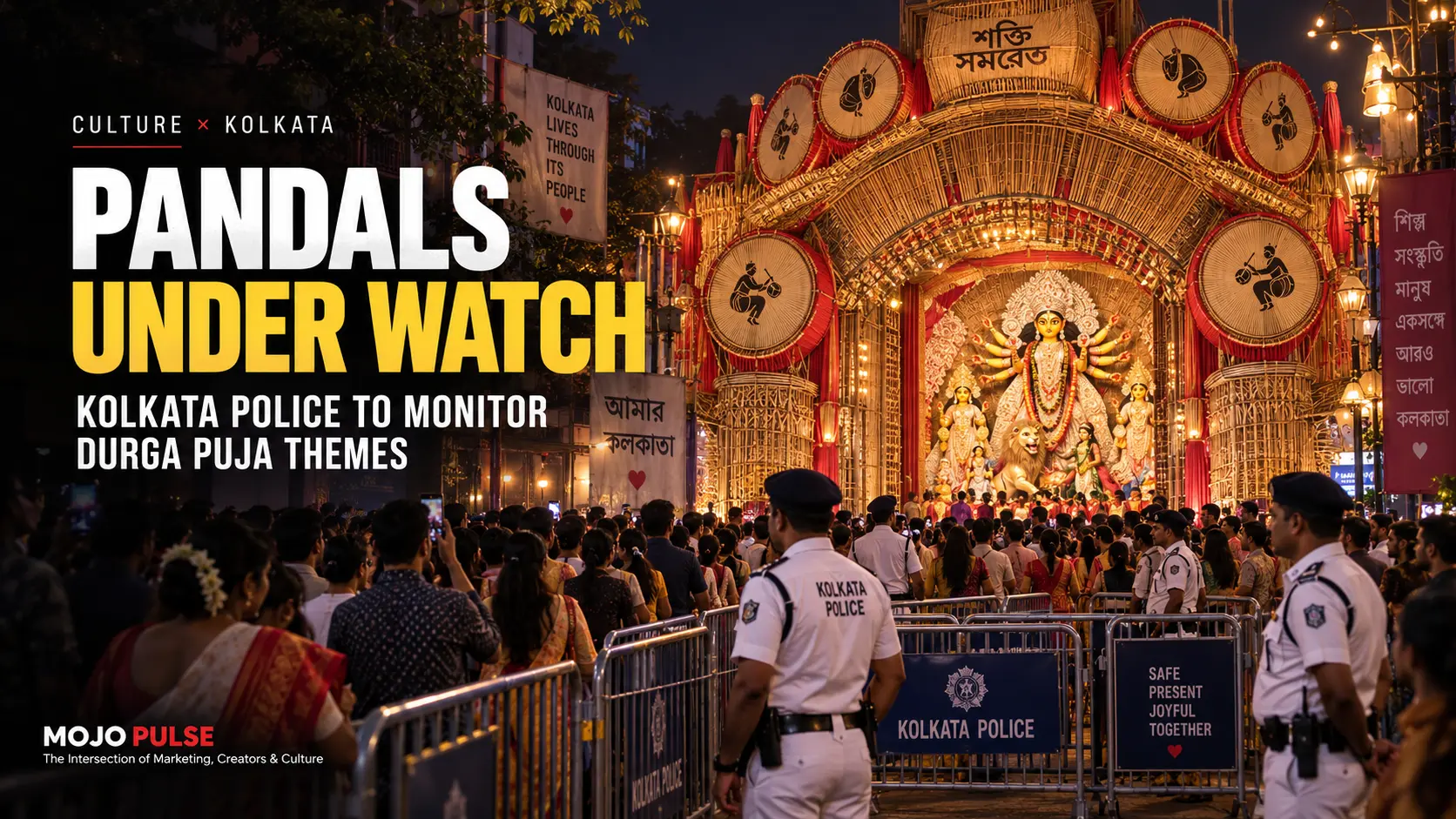
From crowd management and traffic planning to advance scrutiny of themes and layouts, Kolkata Police is preparing early for Durga Puja 2026. But with themed pandals at the heart of Kolkata’s creative identity, the move also raises a larger question: where do safety, sensitivity and artistic expression meet?
Durga Puja in Kolkata has long grown beyond the boundaries of a traditional religious festival.
For a few extraordinary days every year, neighbourhoods are transformed into enormous public art spaces. Streets become galleries, temporary architecture rises across the city, artists experiment with materials and ideas, and millions of visitors move from one installation to another.
Behind that spectacle is an enormous ecosystem of artists, designers, craftsmen, lighting professionals, fabricators, photographers, content creators, sponsors and brands.
For Durga Puja 2026, however, the themes behind some of those pandals are set to receive attention from another quarter: Kolkata Police.
According to recent reports, Kolkata Police has begun its preparations for the upcoming festival, with officers instructed to collect details about major Puja pandals—including their themes and layouts—while simultaneously preparing detailed crowd and traffic management plans.
The development is significant because theme-based pandals have become one of the defining characteristics of Kolkata’s Durga Puja.
And this year, authorities appear keen to know what some of the city’s biggest Puja committees are planning well before the gates open.
Police Planning Begins While Pandals Are Still Being Built
Preparations are starting early.
Police Commissioner Ajay Nand recently held a virtual meeting with officers-in-charge of police stations and senior Lalbazar officials, where instructions were issued for detailed planning around major Durga Puja venues.
Police stations have reportedly been asked to prepare lists of big-ticket Pujas and collect information on their themes and layouts.
Importantly, officers are also expected to estimate potential footfall while pandals are still under construction.
That information can then be used to determine police deployment, pedestrian movement, traffic restrictions and other crowd-management measures before the festival begins.
For Kolkata, where particularly popular pandals can attract enormous crowds, knowing which installations are likely to become viral attractions could prove crucial.
It’s Not Just About Themes — Crowd Management Is a Major Focus
The word “theme” may attract the headlines, but a substantial part of the police directive concerns something far more practical: managing millions of people safely.
Major Puja committees are expected to discuss crowd-management plans with local police.
Separate entry and exit routes are among the measures being emphasised, while authorities also want to prevent visitors from remaining inside high-footfall pandals for unnecessarily long periods.
Photography itself is not expected to be prohibited, but visitors could be discouraged from stopping at points where taking photographs or videos creates congestion.
That is particularly relevant in the social media era.
A visually spectacular Puja installation can quickly become a viral destination on Instagram, Facebook and YouTube. Visitors no longer simply walk through a pandal—they photograph it, film Reels, record Stories, take selfies and create content.
The behaviour of the crowd around an installation therefore becomes almost as important as the number of visitors arriving.
Police may also train volunteers and private security personnel associated with Puja committees in crowd-management practices.
Traffic Around Major Puja Hubs Is Also Under Scrutiny
Traffic management is another major component of the preparations.
Separate operational directives reportedly require physical inspections of pandals and greater coordination between traffic personnel and organisers.
Major Puja hubs including Deshapriya Park, Kasba, Gariahat, Kumartulli, Behala, B K Pal Avenue and Bagbazar are among areas receiving increased attention.
Authorities are looking at entry and exit capacity, barricading, pedestrian movement, emergency corridors and the positioning of vehicles near pandals.
Vehicles are expected to be prevented from stopping or slowing down immediately around major pandals where doing so could interfere with pedestrian flow.
Additional police personnel are also expected around Metro stations to help manage the movement of visitors.
Kolkata Police is additionally expected to coordinate with civic agencies including KMC and KMDA on issues involving roads, street lighting, trees and pedestrian infrastructure.
Taken together, these measures suggest that authorities are trying to understand the entire visitor journey—from arriving in a neighbourhood to entering a pandal and eventually leaving the area.
Why Are Pandal Themes Being Monitored?
This is where the story becomes more complicated.
Earlier police instructions reportedly asked local stations to identify pandals featuring themes considered controversial, sensitive or capable of attracting exceptionally large crowds.
Officers were also instructed to monitor internal disputes within Puja committees where such disagreements could potentially create law-and-order issues.
Kolkata’s themed Durga Pujas have occasionally generated controversy in previous years when installations addressed political events, social issues or other sensitive subjects.
For the police, therefore, knowing about potentially contentious installations in advance can form part of preventive law-and-order planning.
But the discussion around themes has taken on additional significance this year.
The VHP Debate Adds Another Layer
The latest police directive comes amid a separate debate surrounding calls from the Vishwa Hindu Parishad (VHP) regarding the manner in which Durga Puja is represented.
At an August 26 meeting in Salt Lake, VHP representatives reportedly urged organisers and priests to adhere to traditional Sanatani practices and raised objections to what the organisation considers distorted or excessively experimental depictions of the Goddess.
Reports surrounding the meeting indicate that concerns were also raised about some creative interpretations used by Puja committees in previous years.
Puja organisers have indicated that such suggestions would be considered within their respective forums.
The police directive and the VHP’s position should not automatically be treated as the same initiative.
However, their proximity has inevitably placed the subject of pandal themes, tradition and creative interpretation under greater public attention ahead of Durga Puja 2026.
Mojo Pulse Take
Durga Puja Is Also One of Kolkata’s Largest Creative Platforms
There is an important distinction that needs to be made.
Police planning for crowd safety, emergency access and law-and-order is necessary for a festival operating at the scale of Kolkata’s Durga Puja.
But theme-based Puja is also much more than decoration.
It has evolved into one of India’s most remarkable temporary creative industries.
Months of work can go into a single major pandal.
Concept artists develop the central idea. Art directors translate it into a physical environment. Architects and structural teams determine how that vision can actually be built. Craftspeople create installations. Lighting designers establish atmosphere. Sound designers build immersive experiences.
Then come photographers, filmmakers, influencers and digital creators who take those installations to audiences far beyond Kolkata.
Brands and sponsors increasingly participate in the ecosystem as well.
That means conversations around themes don’t affect only Puja committees—they potentially touch an entire creative economy.
When a Pandal Becomes a Viral Destination
There is another reason advance planning has become increasingly important: social media can transform crowd behaviour almost overnight.
A relatively unknown installation can suddenly appear across hundreds of Instagram Reels.
Within hours, people begin adding it to their Puja itinerary.
Creators arrive.
Vloggers arrive.
News channels arrive.
Thousands of additional visitors follow.
The most visually striking pandals are effectively competing for attention in both physical and digital spaces.
That creates an unusual challenge for authorities.
A theme isn’t merely an artistic decision anymore. A sufficiently spectacular concept can become a powerful driver of physical footfall.
From that perspective, asking organisers about themes and expected attractions can make sense as part of crowd forecasting.
But Creative Freedom Remains Important
Kolkata’s Durga Puja became globally distinctive precisely because artists and organisers were willing to experiment.
Traditional Pujas remain an essential part of the city’s cultural landscape, but theme Pujas created another dimension—one where contemporary art, social commentary, architecture, craftsmanship and storytelling could exist alongside religious celebration.
That experimentation has helped make Kolkata’s Puja visually unmistakable.
The challenge for 2026 will therefore be maintaining a sensible distinction between safety oversight and creative oversight.
Police understandably need to know whether a pandal could attract extraordinary crowds, whether its structure is safe, whether emergency access exists and whether a theme presents a foreseeable law-and-order concern.
But artistic experimentation itself should not automatically be equated with controversy.
That distinction will matter.
The Bigger Picture: Creativity, Culture and Crowd Control
Durga Puja presents Kolkata with a challenge few cities experience on this scale.
For several days, religion, art, architecture, entertainment, tourism, food, fashion, advertising, influencer culture and mass public participation all converge.
The city’s streets become the venue.
That means creative freedom and public administration inevitably have to coexist.
For Puja organisers, the message for 2026 appears clear: planning will need to begin earlier, and conversations with authorities are likely to become more detailed.
For artists, the question will be whether increased scrutiny has any meaningful impact on the kinds of concepts they are willing to explore.
For brands and sponsors, reputational sensitivity around the Pujas they associate with may become increasingly important.
And for creators and visitors, crowd etiquette may become a much bigger part of the conversation—particularly when photography and video creation begin obstructing pedestrian movement.
Mojo Pulse Insight
The most interesting part of this story may ultimately not be whether Kolkata Police knows the theme of a pandal.
It is what the development tells us about how Durga Puja itself has changed.
A theme can now influence media coverage, social conversation, creator content, brand visibility and, crucially, physical footfall.
That makes creative decisions operational decisions as well.
Kolkata therefore faces a delicate balancing act this Puja: protecting the freedom that has made the city’s festival one of the world’s most extraordinary celebrations of public art while ensuring that millions of people can experience it safely.
Safety and creativity do not necessarily have to exist on opposite sides of that conversation.
The real test will be ensuring that one does not unnecessarily diminish the other.

Reader discussion
Join the conversation respectfully. Your email address will not be published. Comments are reviewed before appearing.