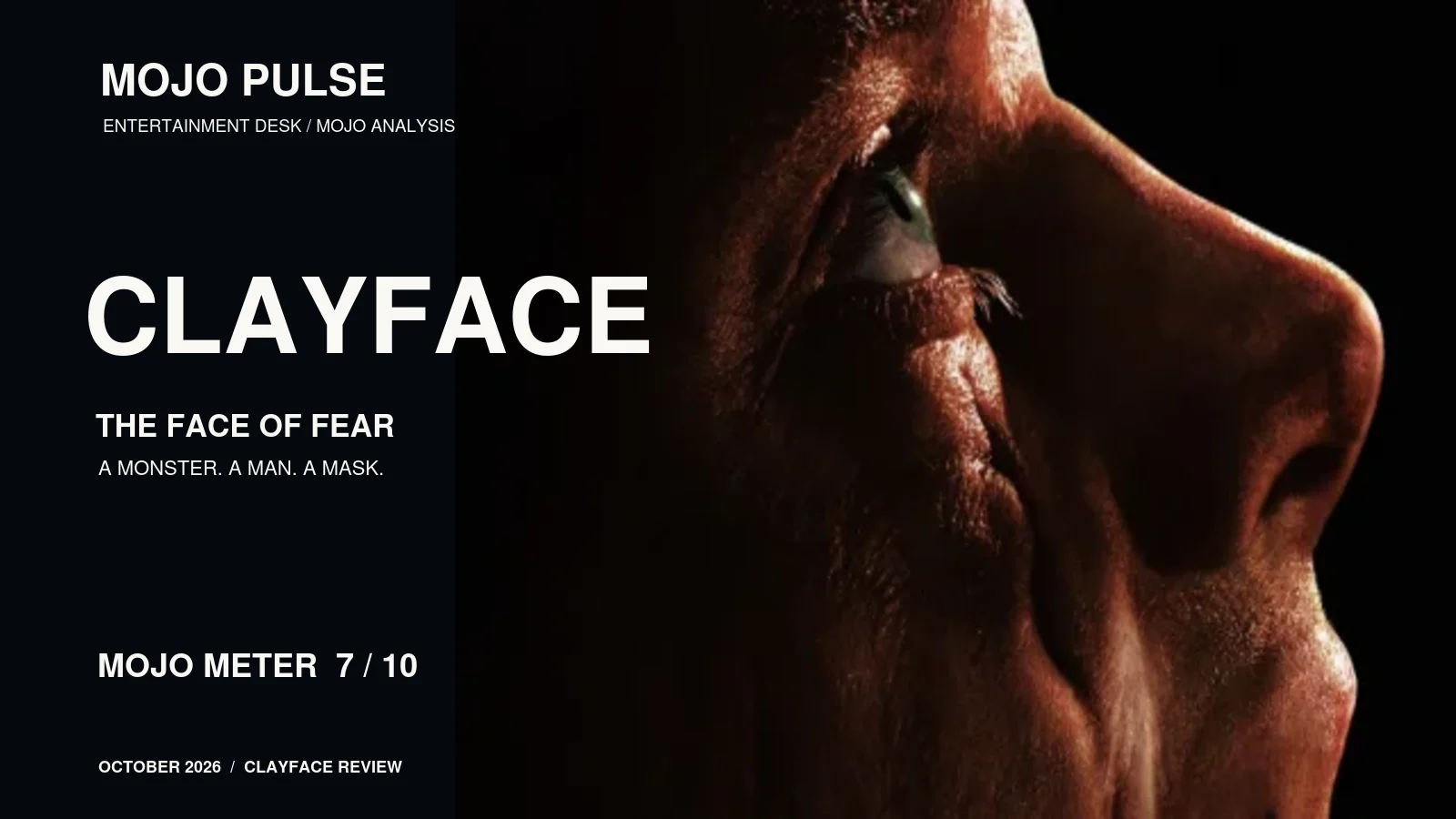
MOJO PULSE ENTERTAINMENT DESK | MOJO ANALYSIS REVIEW
By Joseph Meagher | Updated 25 October 2026 | Horror / Psychological Thriller | Spoiler-light
MOJO METER: 7 / 10
The verdict: An unusually daring turn for DC, powered by Tom Rhys Harries’ wounded performance, grotesque transformation effects and a fascinating question about identity. The horror cuts deep, but the revenge plot eventually becomes more ordinary than the monster.
Review basis: Joseph Meagher’s original MOJO Analysis of the film, developed from verified released material and the range of published critical and audience responses. The score is an editorial synthesis, not a claim of attending a press preview.
What happens to an actor when his face—his greatest professional asset—becomes the one thing he can no longer trust? That is the question I find more compelling than any superhero connection in James Watkins’ Clayface. DC has spent years teaching its audience to expect cities in danger, extraordinary powers and the promise of a larger universe. Here, the terror is smaller and much more intimate: a man’s reflection becomes a stranger.
It is a smart premise for a monster film. It is also a painful one. Matt Hagen is not born monstrous. He is an ambitious performer whose identity has become inseparable from how others see him. When that identity is violently taken away, the world that rewarded his appearance quickly abandons him. What follows is a story about a person desperate to get his life back, only to discover that regaining the face does not necessarily restore the person underneath it.
Clayface at a glance
- Release: 23 October 2026 in the United States and India, with international rollouts beginning earlier that week
- Director: James Watkins
- Story and screenplay: Mike Flanagan; screenplay by Flanagan and Hossein Amini
- Cast: Tom Rhys Harries, Naomi Ackie, David Dencik, Max Minghella and Eddie Marsan
- Music: Volker Bertelmann
- Cinematography: Rob Hardy
- Runtime: Approximately 108 minutes
- Genre: Body horror, psychological thriller and comic-book character drama
The story: a face worth everything, until it is worth nothing
Matt Hagen (Tom Rhys Harries) is a rising actor from Gotham whose career appears to be moving towards the kind of fame he has chased for years. An encounter with crime boss Markos Szabo (David Dencik) ends in a vicious assault that leaves Matt disfigured. Work dries up. People who once admired him begin treating him as a liability. The cruelty that follows is not supernatural; it is society’s familiar habit of measuring human worth through appearance.
Then comes the apparent miracle. Scientist Caitlyn Corr (Naomi Ackie) has developed an experimental regenerative treatment that might undo the physical damage. Matt sees a chance to reclaim his image, his career and his place in the world. What starts as a medical rescue mutates into a nightmare of unstable flesh, blurred identity and revenge.
I would argue that the film’s strongest idea sits in that reversal. At first Matt fears he will never look like himself again. Later, the more horrifying prospect is that he can look like almost anyone—and still fail to recognise the man he has become. His extraordinary abilities do not solve the original wound. They enlarge it.
Tom Rhys Harries: the performance holding the monster together
The most consistent strength emerging from the film’s reception is Tom Rhys Harries. He has the difficult job of giving us a recognisable human being before the visual effects and prosthetics take over. Matt cannot simply be a tragic victim who becomes a spectacular creature. He also has to be vain, ambitious, volatile and capable of making choices that lose our sympathy.
That contradiction gives the character his value. Harries’ Matt is easy to pity when his face is destroyed and his opportunities vanish. The more challenging material comes when pity begins to turn into discomfort. A man who has suffered something terrible may still become responsible for terrible things. The script has its limits, but the lead performance appears to carry that change with a conviction that the plot sometimes lacks.
What interests me about this casting is that Harries is not burdened with the audience’s memory of an established superhero star. His relative unfamiliarity works in the story’s favour. The film is about an identity being constructed and then torn apart; an actor whose screen image is not already fixed gives the character room to collapse in unexpected ways.
Naomi Ackie: the conscience inside the experiment
Naomi Ackie’s Caitlyn Corr is essential because she represents something different from Matt’s obsession with his appearance. Where he sees a cure as a way of recovering status, she must confront the moral consequences of making that cure possible. Her scientific ambition, sympathy and uncertainty create one of the story’s more promising tensions.
There is also a potentially unsettling intimacy between patient and scientist. Caitlyn sees a damaged human being behind the ruined face, while Matt begins to regard her as someone who might restore everything he has lost. But compassion cannot guarantee control, and a doctor who can change a body cannot necessarily rebuild its owner’s judgment.
I wish that conflict were given more space. The film’s romance and emotional relationships have been among the less persuasive elements of the critical conversation. Max Minghella, as detective John Borrelli, is drawn into that part of the story, but the triangle does not always seem as psychologically developed as the film’s physical transformations. Ackie brings intelligence and gravity to the role; the material does not consistently reward her.
David Dencik, Max Minghella and the supporting cast
David Dencik’s Markos Szabo serves as the brutal catalyst for Matt’s fall. He brings the grounded criminal violence that makes this Gotham feel more like a dangerous city than an amusement park for costumed heroes. The character’s function is clear: he turns personal humiliation into an appetite for retaliation.
Minghella’s detective provides the procedural counterpoint to Caitlyn’s research, while Eddie Marsan adds another recognisable dramatic presence to the ensemble. Yet the supporting players collectively point to one of Clayface‘s weaknesses: the film is built around a great central tragedy but sometimes gives the people around it conventional genre responsibilities. They move the plot forward when they could be illuminating different sides of Matt’s fractured identity.
Body horror: the film’s real superpower
For me, the most exciting decision behind Clayface is that it refuses to make its title character’s transformation look clean or aspirational. This is not a sleek superhero upgrade. It is the body becoming unreliable, repulsive and frighteningly malleable.
The prosthetic work gives the film a disturbing physical personality. Faces sag. Skin ceases to behave like skin. The idea of flesh losing its shape is presented as something painful and humiliating rather than a convenient special effect. Some of the reported set pieces turn ordinary actions—touching a face, opening one’s eyes, reaching for an object—into occasions for real dread.
The distinction matters because so much modern comic-book spectacle treats the body as practically indestructible. Watkins moves in the opposite direction. His film reminds us that a human body is vulnerable, messy and capable of betraying us. Even when digital effects assist the illusion, the practical makeup and textures give the nightmare weight.
There is a familiar lineage here: tragic creature films, grimy revenge thrillers and the most uncomfortable traditions of physical transformation horror. But I do not see familiarity of influence as the problem. The problem begins when the screenplay becomes less curious about the implications of the transformation than about who Matt will punish next.
Why Gotham works better without a hero arriving to rescue it
A standalone horror story involving a DC villain could easily become a puzzle of cameos and future franchise promises. Clayface is more interesting for resisting that temptation. Matt’s suffering is allowed to occupy the centre rather than functioning as a footnote in someone else’s superhero mythology.
Rob Hardy’s cinematography leans into a nocturnal, bruised Gotham. The city can feel cold and anonymous, and the mood supports a story about a performer abandoned by the institutions that once admired him. However, some reactions rightly question whether Gotham itself is sufficiently distinctive. The darkness often works as atmosphere, but the city does not always emerge as the living, corrupted character it might have been.
I like the principle of this DC experiment: the universe should be capable of containing horror, crime, comedy and intimate tragedy without forcing every story into the same blockbuster template. Even an imperfect film that makes such a choice has something worth defending.
The weak point: revenge is simpler than identity
The film begins with a psychologically rich contradiction. Matt wants his old identity returned to him, yet the power that grants his wish threatens to erase it altogether. That could sustain a truly disturbing character study. Instead, the narrative sometimes takes the more familiar road of escalating revenge.
Once the plot starts moving between antagonists, confrontations and horror set pieces, the question of who Matt has become can feel secondary to the mechanics of how he will retaliate. Several critics have identified that loss of dramatic focus, and it is the decisive reservation behind my rating.
A great horror film does more than display disturbing images. It changes the way we understand its characters. Here, the images often seem more imaginative than the narrative surrounding them. The film remains unnerving and frequently entertaining, but its story does not always match the courage of its visual design.
The audience divide makes sense
Some viewers and reviewers have welcomed a comic-book film willing to be ugly, cruel and relatively self-contained. Others have found the screenplay routine, the pace uneven or the supporting relationships insufficiently convincing. I can see why those responses diverge without assuming that either side is missing the point.
Approach Clayface expecting a conventional superhero adventure, and its bleakness and gore may seem alienating. Approach it as a body-horror tragedy, and its transformation imagery and haunted leading man become the attraction—although the conventional revenge structure may then feel frustratingly safe. A film can succeed as a bold change of direction while still falling short of its own strongest idea.
MOJO METER: 7/10 — the final verdict
What works: Tom Rhys Harries’ complex central performance; Naomi Ackie’s intelligence and emotional grounding; memorable prosthetics; a compelling loss-of-identity premise; and the willingness to let a DC story become genuinely uncomfortable.
What could be better: A familiar revenge trajectory, underdeveloped secondary relationships, uneven pacing and a version of Gotham that could have more character.
My verdict: Clayface is an admirable horror experiment built around an unsettling human truth: when a person becomes valued only for the face the world recognises, losing that face can feel like losing everything. Watkins gives that fear grotesque visual form, and Harries finds a wounded man beneath the deformation. I wanted the writing to be every bit as inventive as the effects. It is not, but there is more than enough craft, ambition and uncomfortable imagination here to justify a solid 7/10 on the MOJO METER.
Watch the official Clayface trailer
Watch the official promotional trailer for a spoiler-light introduction to Matt Hagen’s transformation, the cast and the film’s disturbing tone.
Explore the Clayface film profile and the Mojo Pulse Movie Database for more entertainment coverage.
Editorial note: MOJO Analysis combines Joseph Meagher’s original critical perspective with independently researched material and published audience and critic responses. This review is not represented as a first-hand preview screening.

Reader discussion
Join the conversation respectfully. Your email address will not be published. Comments are reviewed before appearing.