
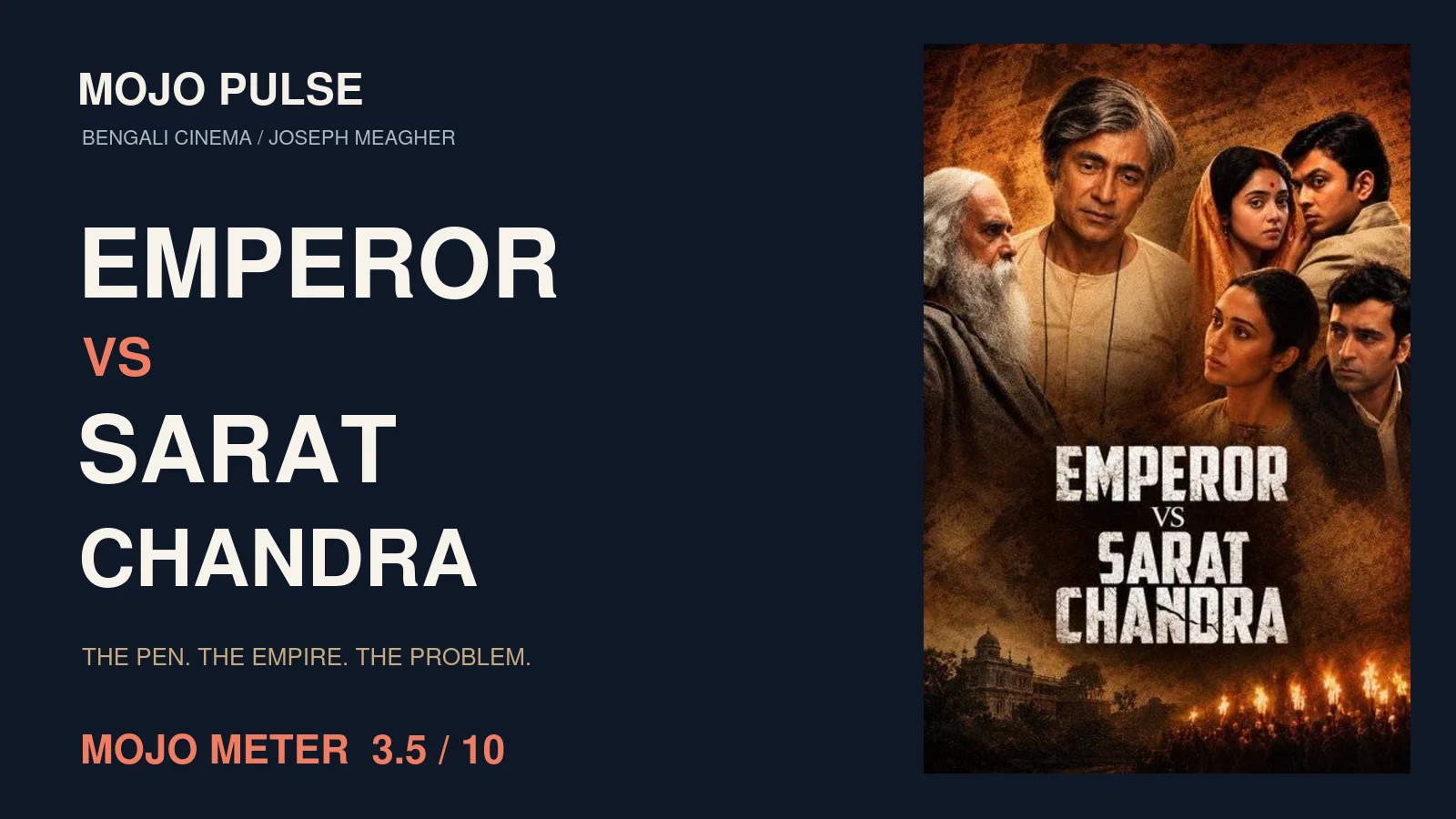
MOJO PULSE ENTERTAINMENT DESK | MOJO ANALYSIS
By Joseph Meagher | 25 October 2026 | Bengali historical drama | Spoiler-light
MOJO METER: 3.5 / 10
My verdict: An important story about the freedom to write, supported by genuinely good actors, is buried beneath a sluggish opening, an overloaded narrative and colonial-era AI imagery that repeatedly breaks the illusion. The film has a strong reason to exist; it needed a more disciplined way to tell its story.
Review basis: Joseph Meagher’s original editorial evaluation drawing on documented production details and published Bengali and English critical reception. This is not represented as a first-hand preview or cinema screening.
A book that frightened an empire should make for compelling cinema. That is why I find Emperor vs Sarat Chandra so frustrating. Srijit Mukherji has a powerful subject: Sarat Chandra Chattopadhyay, a novelist celebrated for his understanding of ordinary people, writes a revolutionary work that colonial authorities try to silence. There is a clear conflict, a brave protagonist and a question that has lost none of its urgency. Yet the film appears determined to take the longest possible route towards that conflict.
The central idea deserves far more attention than the film’s flourishes. Pather Dabi, published in 1926 and banned by British authorities in January 1927, becomes the meeting point between the writer’s conscience and the empire’s fear of dissent. Mukherji also places the novel’s fictional revolutionary, Sabyasachi, alongside its real-world creator. The contrast between resistance through literature and resistance through action could have been a fascinating conversation between two worlds. Instead, I find the sheer number of threads pulls focus away from both.
The story: the writer, the rebel and the empire
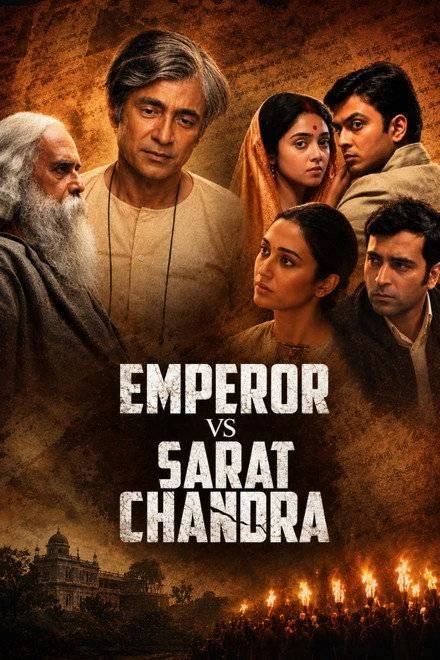
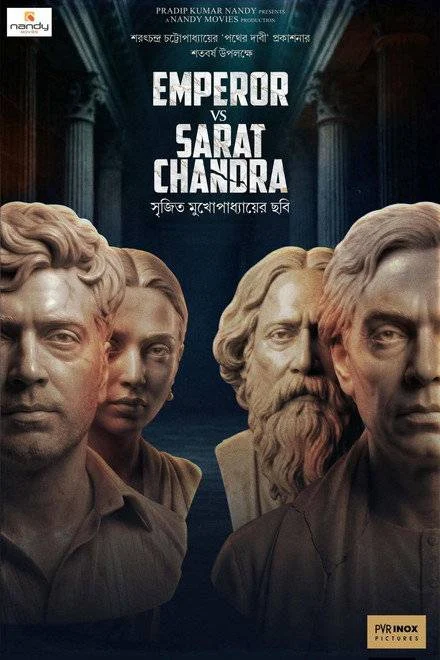
Tota Roy Choudhury plays Sarat Chandra, while Abir Chatterjee plays Sabyasachi, the revolutionary imagined in Pather Dabi. The film moves between the writer’s political awakening, the novel’s fictional struggle and the controversy over its prohibition. Sarat Chandra’s relationship with Rabindranath Tagore—and their differences about the responsibilities of an artist—offers another thoughtful strand.
On paper, these are connected arguments. On screen, they compete for attention. When the film should be tightening its grip on the government’s attempt to control a book, it keeps opening another dramatic door. The resulting structure feels less like a carefully woven historical drama and more like several interesting film ideas trying to share the same 135 minutes.
What works: Tota, Abir and a committed ensemble
If there is one reason I would defend this film, it is Tota Roy Choudhury. Playing a literary figure familiar from photographs and public memory is difficult. Tota’s strength is in suggesting both the writer’s vulnerability and his refusal to surrender his convictions. He brings a quiet force to Sarat Chandra—a person rather than a monument—and seems to understand that courage does not always announce itself loudly.
Abir Chatterjee supplies a different energy as Sabyasachi. His composure and intensity give the novel’s revolutionary a presence of his own. I like the contrast between Tota’s restrained author and Abir’s purposeful fictional creation. It might have carried the entire film had the screenplay trusted the two characters enough.
Mimi Chakraborty provides a credible presence in the ensemble, while Sanjoy Nag contributes weight as Rabindranath Tagore. The supporting performers help anchor the period and its arguments, even when the writing keeps moving the centre of the story. Makeup and costume work also do valuable work in establishing the historical characters.
Where it fails: slow pacing and a screenplay trying to do everything
My biggest objection is the pacing. The first half spends so much time preparing us to appreciate Sarat Chandra’s importance that it delays the conflict which should be driving the film. I don’t need a historical drama to race, but I do need it to know when its central struggle has begun.
Once the narrative brings together Sarat Chandra, Sabyasachi, colonial censorship, Tagore, the politics of nationalism and detours into other literary worlds, the momentum becomes uneven. Important themes arrive, but they are not always given enough space to register. A leaner screenplay could have made the ban on Pather Dabi feel more urgent, and the writer’s resistance more personal.
The AI visuals: an expensive-looking distraction
I am not opposed to generative AI as a production tool simply because it is new. I am opposed to an image that takes me out of the story it is meant to support. That is the problem with the film’s colonial-era recreations. Several reviewers have noted that the digitally generated settings sit awkwardly beside the live-action material, undermining the credibility of the period world.
There is an irony here. The actors and makeup artists work to persuade us that these people inhabit a recognisable Bengal. Then a synthetic-looking environment can make the moment feel manufactured rather than lived in. Some critics have been more positive about the visual treatment, but for my assessment this lack of consistency counts against the film. Historical authenticity is not a matter of expensive scenery. It is the feeling that everything in the frame belongs to the same world.
Music: Srijit’s most convincing experiment
The soundtrack is one of the film’s better ideas. Mukherji takes on music composition for one of his own films, drawing on Rabindrasangeet, period-inspired songs and the spirit of political protest. The freedom song Shoite Shoite, performed by Timir Biswas, helps connect the music to the material’s resistance theme. The wider credits also include Indraadip Dasgupta’s background score.
I think this musical ambition is more persuasive than the visual excess. The songs are rooted in the film’s cultural world; they do not need to create that world artificially. Even so, the music cannot repair the stop-start rhythm of the screenplay.
Why the film’s ideas still matter
At its heart is a question worth asking in any generation: when an artist challenges political power, how much of their public identity belongs to the audience—and how much must remain their own? The attempt to ban a novel, the pressure on a writer to soften his convictions and the uneasy place of art in political life are all relevant far beyond colonial Bengal.
That makes the missed opportunity more disappointing. I wanted a film confident enough to hold onto that single, dangerous idea. I find a work that respects the subject but too often mistrusts the simplicity of its own dramatic centre.
MOJO METER verdict: 3.5/10
What I liked: Tota Roy Choudhury’s deeply committed portrayal of Sarat Chandra; Abir Chatterjee’s assured Sabyasachi; Mimi Chakraborty and the supporting cast; the themes of free expression and dissent; the makeup and costume work; and the musical choices.
What held it back: A first half that takes too long to arrive at the real battle, awkwardly integrated AI backgrounds, unnecessary narrative diversions and a 2-hour-15-minute screenplay that struggles to balance history and fiction.
My final assessment: Emperor vs Sarat Chandra is rich in subject and talent but poor in discipline. I admire what it wants to say about the power of words. I wish it had trusted those words more, and its digital spectacle less. MOJO METER: 3.5/10.
Watch the official trailer
The Nandy Movies trailer introduces the film’s two parallel worlds and its historical conflict.
See the Emperor vs Sarat Chandra film profile for the poster and production details. More releases are available in the Mojo Pulse Movie Database.
Editorial disclosure: The 3.5/10 MOJO METER is an original, reception-informed editorial assessment written in Joseph Meagher’s voice. It is not presented as an independently attended screening review.
Reader discussion
Join the conversation respectfully. Your email address will not be published. Comments are reviewed before appearing.