KOLKATA, 25 October 2026 | From the Breaking News Desk. Jogen Chowdhury, one of the defining figures of modern Indian painting, died in Kolkata on Sunday morning at the age of 87. His passing closes a remarkable journey that began in undivided Bengal, crossed the upheavals of Partition and the art schools of Paris, and returned repeatedly to the streets, people and cultural institutions of Kolkata and Santiniketan.
Ruby General Hospital said the artist died at approximately 10:15 AM on 25 October. He had been undergoing treatment for myeloproliferative neoplasm, a rare blood cancer, for more than a year. Hospital reports said he was admitted on 16 October and his condition deteriorated following an infection and other complications. The detail of his final illness matters to the record, but his public legacy was built over more than six decades of painting, drawing, teaching and cultural work.
Chowdhury was also a former Trinamool Congress member of the Rajya Sabha from 2014 to 2020. Yet it was his unmistakable visual language the delicate lines, densely marked bodies, sharp observation and an often unsettling view of human nature that made his name instantly recognisable across Indian art.
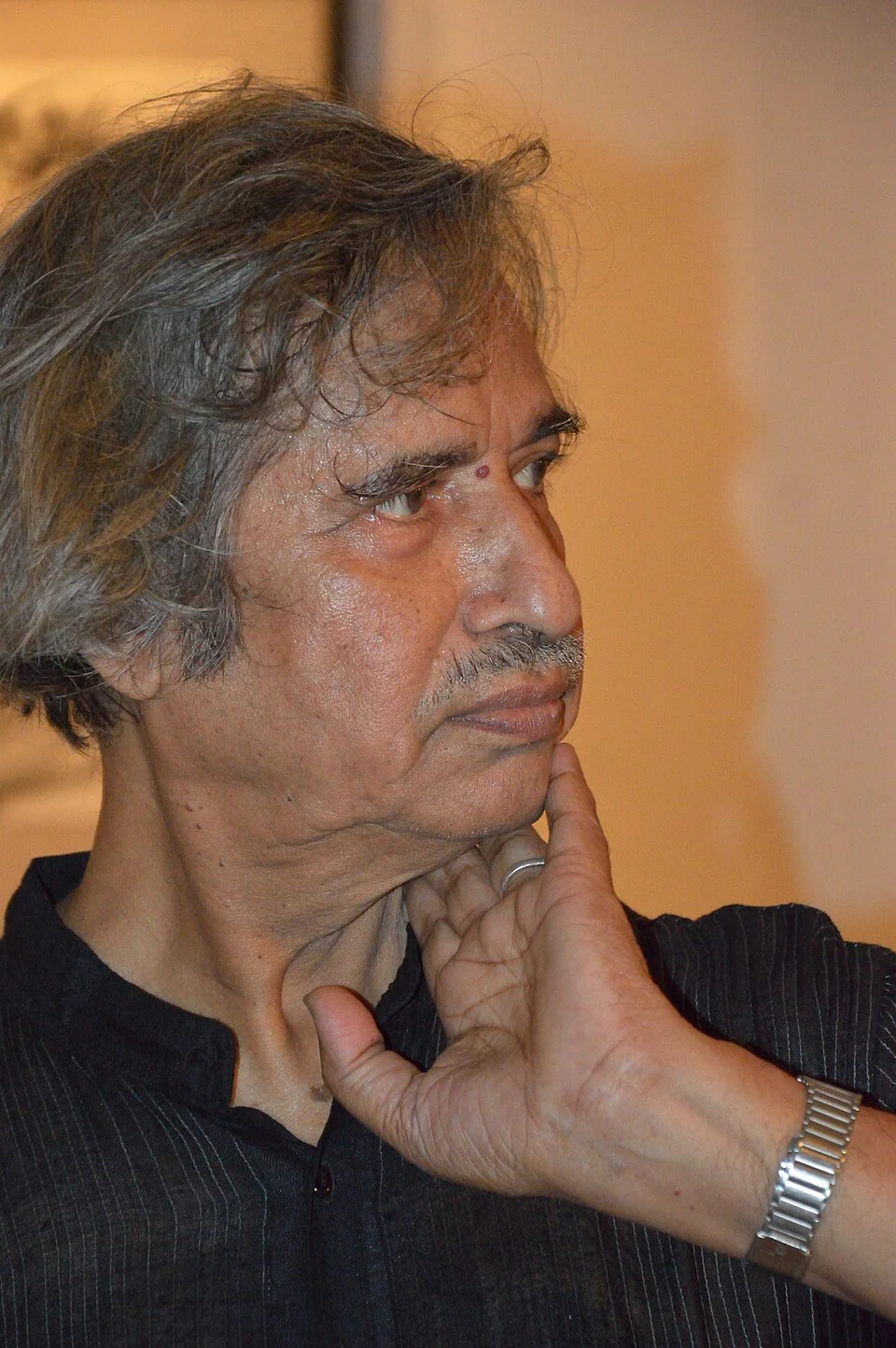
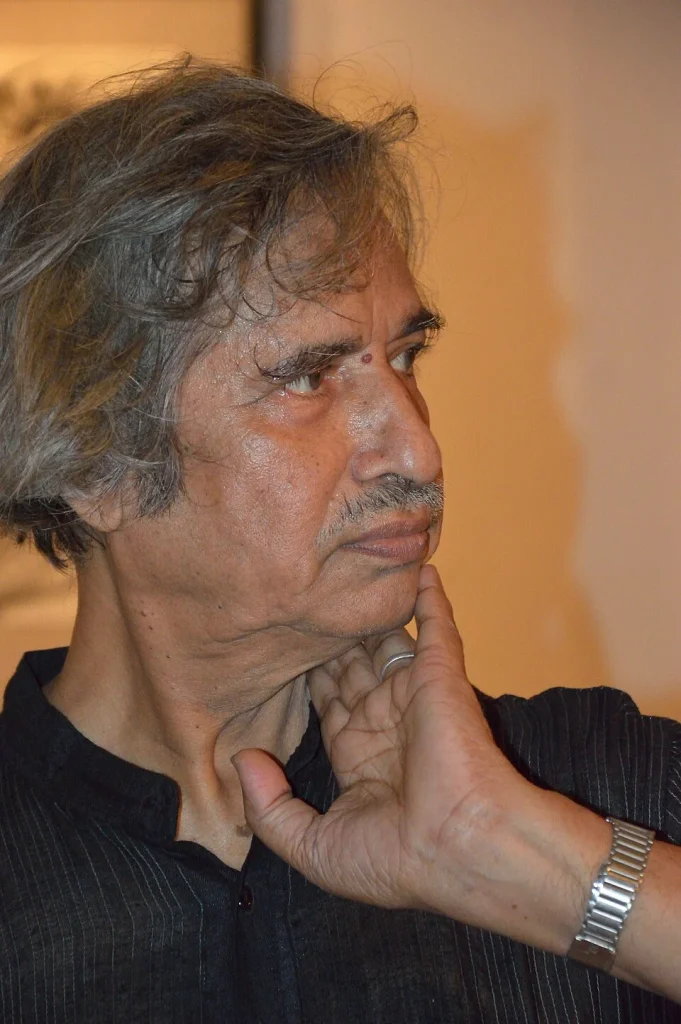
Featured portrait photographed by Biswarup Ganguly, CC BY 3.0
From Faridpur to the art studios of Kolkata
Born in 1939 in Daharpara, Faridpur, in what was then undivided Bengal and is now Bangladesh, Jogen Chowdhury grew up surrounded by visual traditions. Accounts of his early life describe how his mother’s alpana the decorative floor patterns made for everyday and ceremonial occasions—helped draw him towards art before formal training began.
His family moved to Calcutta following Partition. The dislocation of those years did not become a simple illustration of history in his mature work; rather, the precariousness of ordinary life, human vulnerability and contradictions beneath respectable appearances became recurring concerns. The young artist enrolled at the Government College of Art and Craft, Kolkata, in 1955, completing his studies in 1960.
After teaching art and working in design, he travelled to Paris in 1965 on a French government scholarship. He studied at the École Nationale Supérieure des Beaux-Arts and was also associated with the Atelier 17 printmaking environment. Exposure to European modernist practice deepened his experiments, but he did not abandon the memory of Bengali visual culture. That tension between local experience and international modernism became central to his mature identity.
The unbroken line: What made his art different
For many viewers, a Chowdhury image could be identified before the signature came into focus. His figures often appear bent, elongated, compressed or swollen. Faces, hands and torsos carry intricate cross-hatching, hundreds of fine strokes that produce texture, shadow and psychological pressure without relying on photographic realism.
His line was more than a way of outlining a body. It could describe a gesture, suggest irony, expose frailty or draw attention to the distance between outward appearance and inner feeling. The people in these works can look tender and vulnerable one moment, absurd or disquieting the next. Their bodies are not idealised; their distortions feel intentional, part of a larger observation about power, desire, suffering and social life.
He worked extensively in ink, pastel and watercolour, and also made paintings in oil. Critics have traced echoes of folk imagery, the Kalighat painting tradition and Bengal’s popular visual vocabulary through his modern figures. What emerged, however, was recognisably his own: a particular balance of flowing contours and densely worked surfaces.
Paintings, exhibitions and recognition
Chowdhury’s body of work ranges from intimate sketches to substantial figurative compositions. Among the pieces and series associated with his mature practice are Day Dreaming (1979), Ganapati the Lord (1977), works featuring solitary men and women, and later variations on the human body as a social and emotional landscape. The subjects are not always explained literally; the possibilities of interpretation are part of their power.
His reputation developed through exhibitions in India and abroad, including presentations in Paris and at important contemporary-art venues. In 1966 he received the Prix de la Jeune Peinture in Paris, and in 2001 the Madhya Pradesh government honoured him with the Kalidas Samman. His work entered significant public and private collections, including the National Gallery of Modern Art and Rashtrapati Bhavan.
A major retrospective at Kala Bhavana, Santiniketan, in 2013 brought together works spanning his student years and mature career, allowing audiences to see how his sense of line, form and subject changed over decades. That continuity—rather than any single painting—helps explain why his place in the history of Indian modernism is so substantial.
Teacher, curator and institution builder
Chowdhury’s influence extended well beyond the studio. He worked as an art teacher and designer early in his career, later served as a curator or Keeper of Art at Rashtrapati Bhavan, and joined the faculty at Kala Bhavana, Visva-Bharati, Santiniketan, in the late 1980s. Generations of students encountered him both as a practicing artist and as a mentor who could connect technical skill with the cultural world outside the classroom.
He contributed to conversations about art through journals and public initiatives, including Art Today, associated with fellow artist Shuvaprasanna. In Kolkata he also established Charubasona, inaugurated in 2019 as a space to preserve and present his work and associated cultural material. His involvement with galleries, artists, students and exhibitions gave him an institutional role that outlasted changing fashions in the art market.

A painter in the Rajya Sabha, and in the life of Bengal
In 2014, Chowdhury entered the Rajya Sabha as a Trinamool Congress representative, serving until 2020. His public role made an already recognised cultural figure more visible in parliamentary debate, but his art remained a separate, continuing pursuit. Accounts of those years describe how he sketched personalities in the chamber between proceedings, turning the habits of an observant artist towards another kind of public theatre.
His connections with Bengal’s cultural life reached into Kolkata’s exhibitions and Durga Puja art environments, where artists have increasingly contributed installations, themes and public-facing visual ideas. Chowdhury belonged to an era when painting, literature, politics and public festivals often shared the same conversation in the city.
Tributes from political leaders, fellow painters and cultural institutions on Sunday reflected these overlapping identities: the artist of remarkable technical control, the teacher remembered for guidance, the institution builder and the former parliamentarian. Those roles should not obscure one another, but the enduring achievement remains the work on paper and canvas.
Why Jogen Chowdhury’s legacy matters
The loss to Kolkata is not only of a celebrated name. Chowdhury demonstrated that a distinctly Bengali visual memory could speak in a contemporary international language without becoming either nostalgic illustration or imitation of European painting. His figures could be intimate and political, familiar and strange, composed with relatively modest materials yet rich in ambiguity.
For younger artists, his career offers a longer lesson: artistic identity can grow out of close observation, sustained practice and willingness to take formal risks. For the wider public, it offers a reminder that art is not confined to decorative beauty. A drawing can also hold discomfort, vulnerability, humour and the unresolved tensions of a society.
Jogen Chowdhury’s life connected Faridpur, Kolkata, Paris, New Delhi and Santiniketan. His lasting address, however, is in that deceptively fluid line through which he made a human figure feel impossible to mistake for anyone else’s.
Jogen Chowdhury: Life and career at a glance
| 1939 | Born in Faridpur in undivided Bengal. |
|---|---|
| 1955–1960 | Studies at the Government College of Art and Craft, Kolkata. |
| 1965–1967 | Trains in Paris on a French government scholarship. |
| 1966 | Receives a young-painters’ award in Paris. |
| 1970s–1980s | Develops his distinctive figurative idiom and holds major exhibitions. |
| Late 1980s | Begins teaching at Kala Bhavana, Santiniketan. |
| 2001 | Receives the Kalidas Samman. |
| 2014–2020 | Serves in the Rajya Sabha. |
| 2019 | Establishes Charubasona in Kolkata. |
| 25 October 2026 | Dies in Kolkata at 87. |
MOJO PULSE will incorporate any important confirmed details about public memorials or the artist’s institutional legacy into this report as they become available.